Decks, porches and sheds
Skunk removal without anyone getting sprayed
The safest way to remove a skunk is to let it leave and then close the door. One-way exclusion, a buried mesh footer and odor treatment end the problem without trapping or handling the animal.
Updated October 2026
This treatment, at a glance
- Job type
- Exclusion and deodorizing
- Spring check
- Young located first
- Spray risk
- Avoided by design
- Line
- Answered 24/7
Skunk removal in Los Angeles is done by exclusion so nobody gets sprayed: a one-way door on the den under the deck, porch or shed lets the skunk leave at night, then a buried mesh footer and sealed entry keep it from coming back, and the den area gets odor treatment. Spring dens may hold young, so timing matters. Call (323) 329-3792 any hour.
First response
If a skunk is under the house
Keep pets inside at night
Most sprayings happen when a dog finds the skunk after dark. Leash pets for evening yard trips until the job is done.
Do not block the hole
A skunk sealed in will dig out elsewhere, often under a slab or into a crawl space, and the smell gets worse.
Watch for odd behavior
A skunk out in daylight acting sick or unafraid should be reported to animal control and avoided entirely.
How removal works
Exclusion without the spray
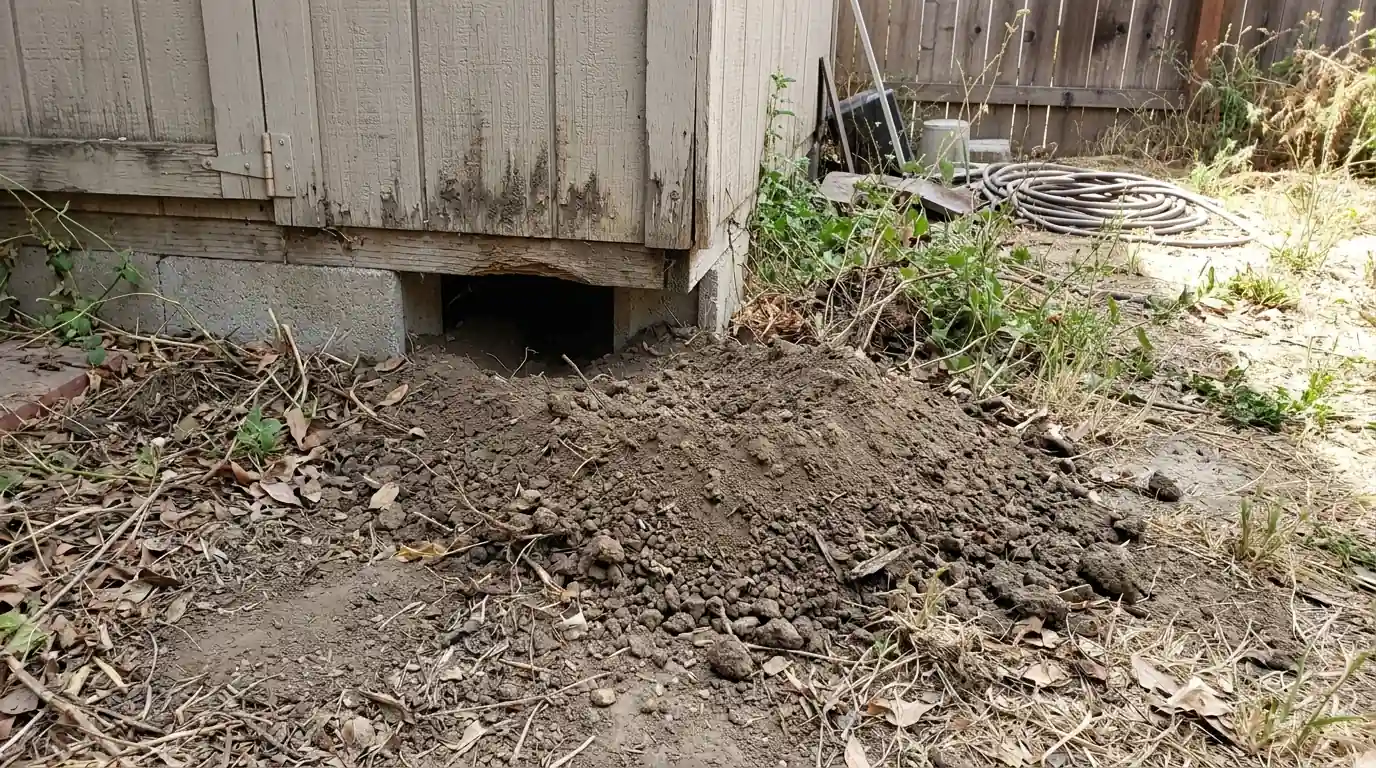
Skunks den under decks, porches, sheds, concrete slabs and in crawl spaces, and they dig, so a small gap under a structure is all the invitation they need. At night they forage in lawns for grubs, leaving small cone-shaped holes, and raid pet food and trash. The smell usually announces them before anyone sees one.
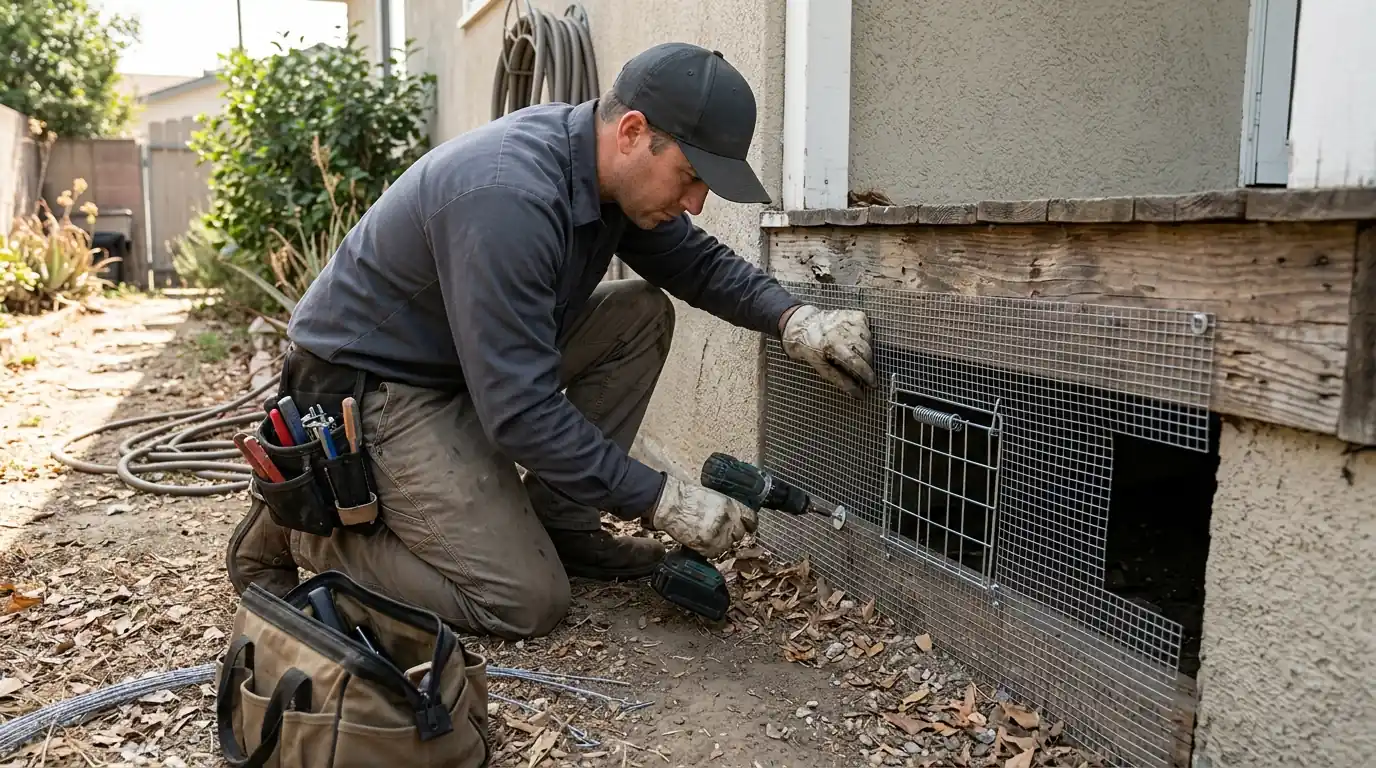
Trapping a skunk means handling an animal whose defense is spraying the person handling it, and moving it away is generally not allowed in California anyway. Exclusion avoids both problems. The inspection finds the den and every other gap, a one-way door goes on the active entry, and the other openings are closed. Once the skunk has left, which is confirmed before anything is sealed, the entry is closed and an L-shaped footer of galvanized mesh is buried along the base of the deck or shed so it cannot dig back under. In spring, when mothers have young in the den, the work is timed so the family leaves together. The den area is then cleaned and treated to neutralize odor.
The visit
From smell to sealed
Inspect
Den, entries, lawn damage and signs of young checked.
Exclude
One-way door on the den entry; secondary gaps closed.
Confirm empty
Monitoring until the skunk, and any young, have left.
Seal and footer
Entry closed, buried mesh footer along decks and sheds.
Deodorize
Den area cleaned and treated with odor neutralizers.
Local pressure
Skunks in the suburbs
Striped skunks are common across Los Angeles and Orange County, especially near hillsides, parks, flood channels and older neighborhoods with raised porches and wooden decks. Irrigated lawns full of grubs and easy access to pet food keep them close to homes. Breeding season runs late winter into spring, when dens under structures are most likely to hold young. Skunks are also among the hosts linked to flea-borne typhus in eastern LA and Orange counties, and one of the main rabies carriers on land in California, both reasons to keep them out from under the house rather than coexist.
What it costs
How skunk removal is priced
Pricing depends on the den location, the length of mesh footer needed around decks, porches or sheds, whether young are present and how much odor treatment is required, quoted after inspection. For scale, exclusion work on a typical LA home runs in the $600-$1,200 range, with smaller single-entry jobs below that.
Common questions
Asked before booking this service
The smell is the usual giveaway, often strongest at night or after a disturbance, along with small holes dug in the lawn where it hunted grubs, and a den entry under a deck, porch, shed or foundation with dirt pushed out.
Keep the dog outside, check the eyes and rinse them with clean water if they were hit, then wash with a mix of hydrogen peroxide, baking soda and a little dish soap rather than tomato juice. Call your vet if the eyes stay red or the dog seems unwell. Then call us, because the skunk is still nearby.
Exclusion is designed to avoid that. Instead of trapping and handling a skunk, a one-way door lets it leave the den on its own at night, and the entry is sealed once it is gone. California rules generally do not allow trapped wildlife to be moved and released elsewhere, which is why exclusion, letting the animal leave on its own and closing the way back in, is the standard approach around homes.
Skunks are one of the main land animals that carry rabies in California. A skunk active in daylight, acting confused or aggressive, or approaching people is a reason to keep everyone away and contact local animal control. Any bite or scratch needs medical attention right away.
Yes. After the skunk is out, the den area is cleaned and treated with odor neutralizers that break down the spray compounds. Odor that has soaked into soil or wood under a deck may take a little time to fade completely after treatment.
Related treatments
Often booked alongside this one
The line is on right now
Smell coming up through the floor?
Call any hour. The visit finds the den and starts exclusion without anyone getting sprayed.
Answered 24/7, including weekends and holidays.
Call us or find us
- Phone
- (323) 329-3792
- Hours
- Open and answering 24/7, every day
- Service office
- 3123 Cahuenga Blvd W #390, Los Angeles, CA 90068
- Head office
- 7623 Atlanta Ave, Ste 284, Huntington Beach, CA 92646
- Coverage
- Los Angeles, Orange and neighboring counties