Offices, retail, warehouses and more
Commercial pest control for Los Angeles businesses
A pest sighting in a business costs more than the pest does: failed audits, lease disputes, reviews. A documented recurring program keeps the building quiet and the paper trail clean.
Updated October 2026
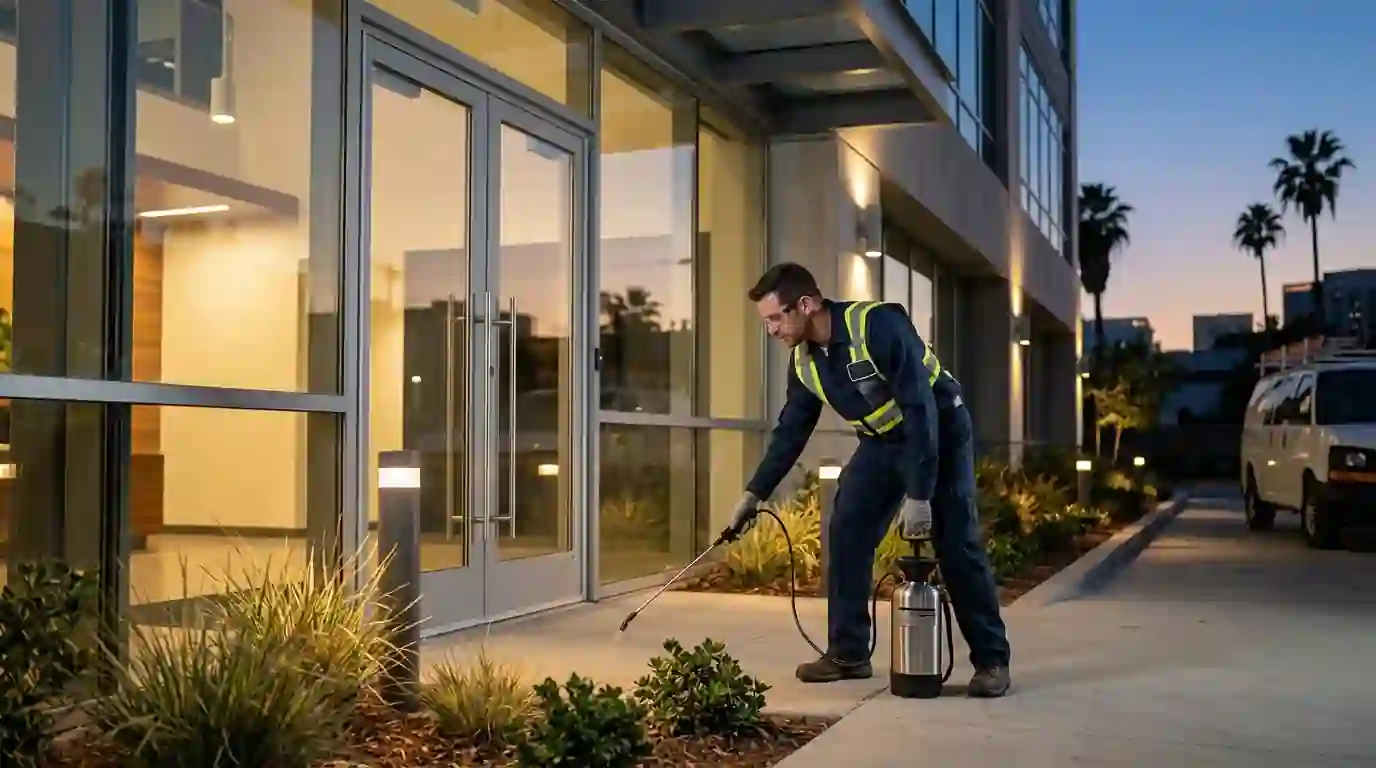
This treatment, at a glance
- Job type
- Recurring commercial program
- Scheduling
- After-hours service standard
- Reports
- Documented every visit
- Line
- Answered 24/7
Commercial pest control in Los Angeles runs as a documented, scheduled program: an initial inspection of the facility, treatment of anything active, then recurring service sized to the business, with reports your landlord, auditor or corporate office will accept. After-hours service is standard. Call (323) 329-3792 to set up an inspection.
What the program covers
Built around the facility, not a template
Every commercial account starts with a facility walk: entry doors and dock doors, trash and compactor areas, break rooms, storage, drop ceilings, utility and riser rooms, and the building perimeter. Those are the pressure points where roaches, mice and flies get in and get established, and the first report maps which ones matter for your building.
Service after that is recurring and quiet. Placements go in stations, voids and perimeters rather than open areas, scheduled when the business is closed wherever possible. Monitoring devices stay in place between visits so trends show up in the reports before they show up on the floor.
A problem between visits does not wait for the schedule. The line is answered around the clock, and an emergency visit to an account is part of the account.
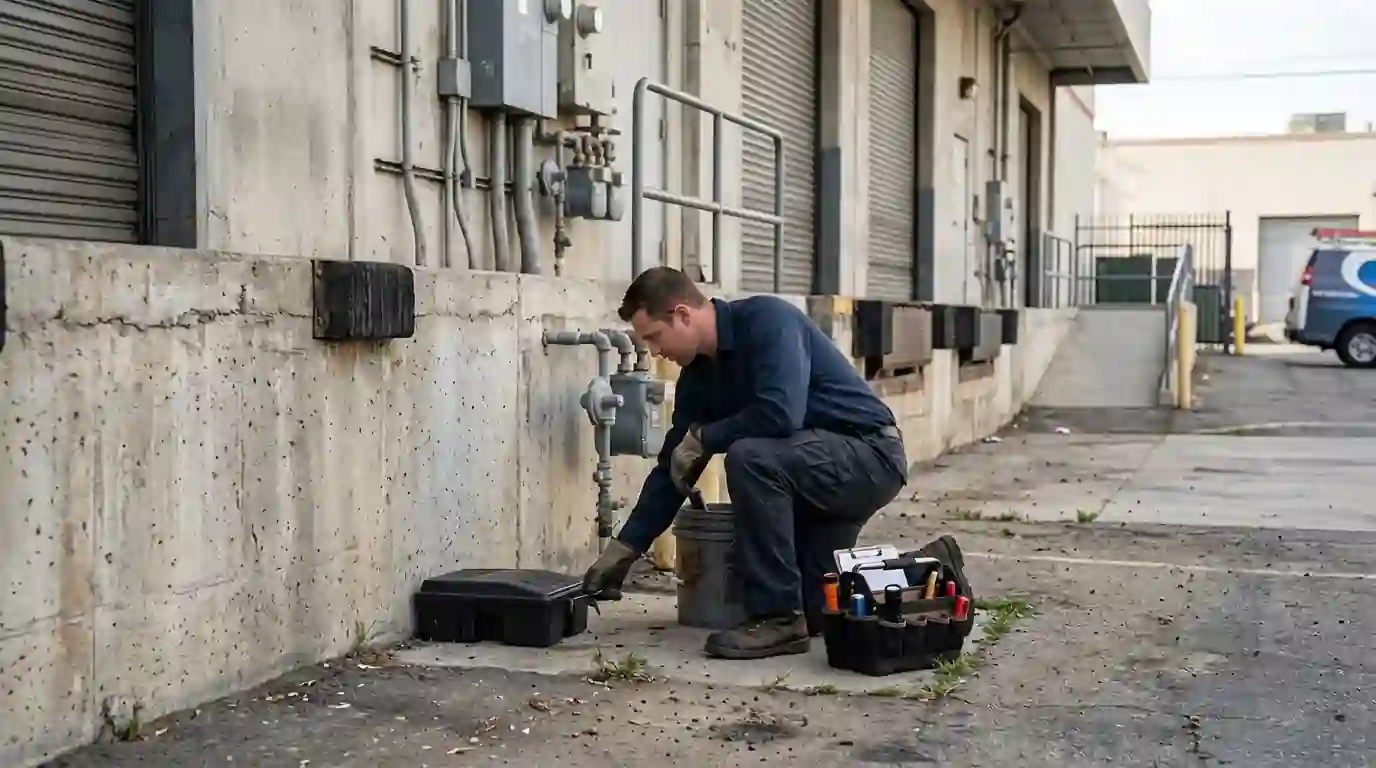
Facility types
Who this program fits
Offices and retail
Discreet scheduled service, break-room and kitchenette focus, and documentation the property manager actually asks for.
Warehouses and distribution
Dock-door exclusion, interior and exterior rodent station lines, and stored-product pest monitoring in racking.
Multi-unit and HOA common areas
Hallways, trash rooms, laundry rooms and exteriors, coordinated with in-unit work through property management service.
How service runs
The commercial service cycle
Facility inspection
A documented walk of the building's pressure points, with findings mapped by area.
Initial knockdown
Anything active gets treated on the first visit, after hours where the business needs it.
Recurring schedule
Monthly or quarterly service sized to the facility, with monitoring in place between visits.
Reporting
Each visit documented: findings, products, placements. The trail holds up for audits and leases.
Between-visit response
Sightings between scheduled visits get a call-out, not a wait for the next date.
Local pressure
What LA buildings are actually up against
Commercial buildings in Los Angeles carry pressure homes do not. American and Oriental roaches move through sewer and drain lines into ground floors and utility rooms. Roof rats work the utility lines between buildings and settle into drop ceilings and dock areas, and with California's AB 1788 restricting the strongest rodenticides, lasting commercial rodent work here is built on exclusion, trapping and station monitoring rather than bait alone. Dumpster corrals and compactors feed fly pressure straight into rear doors through the long warm season.
What it costs
How commercial pricing works
Commercial accounts are priced per facility rather than from a flat menu: square footage, facility type, pest pressure and service frequency set the number, which is why the honest first step is the inspection rather than a phone quote. For scale, standard quarterly service on small spaces starts near residential rates, in the $150-$250 per visit market range, and steps up with size, frequency and documentation needs. The inspection comes back with a firm recurring price in writing.
Common questions
Asked before booking this service
Yes, and for most commercial accounts that is the default. Treating a retail floor, office or warehouse outside business hours means no customers around products, no disruption, and better results, since roaches and rodents are active at night anyway.
Service reports document what was found, what was applied and where, with product names and placements, so the paper trail holds up for audits, landlords and corporate requirements.
Yes. Commercial work runs on a recurring schedule sized to the facility and its pressure: monthly is common for food-adjacent businesses, quarterly for offices. Emergency visits between scheduled service are part of the account, not an extra negotiation.
Offices, retail, warehouses, apartment and HOA common areas, medical and dental suites, gyms and schools. Food service has its own page because the standards differ: see restaurant pest control.
The lease decides it, and in LA commercial leases it usually lands on the tenant for their own suite and the landlord for common areas and the building shell. We service both sides and can split documentation accordingly.
An initial inspection can usually run within a day or two, and active problems get treated on that first visit. The recurring schedule starts from whatever the inspection shows.
Related treatments
Often booked alongside this one
The line is on right now
Need a facility looked at this week?
Tell us the building type and what has been seen, and we will schedule the inspection around your hours, not ours.
Answered 24/7, including weekends and holidays.
Call us or find us
- Phone
- (323) 329-3792
- Hours
- Open and answering 24/7, every day
- Service office
- 3123 Cahuenga Blvd W #390, Los Angeles, CA 90068
- Head office
- 7623 Atlanta Ave, Ste 284, Huntington Beach, CA 92646
- Coverage
- Los Angeles, Orange and neighboring counties