Attics, rooflines and fruit trees
Tree squirrel removal by exclusion and repair
Squirrels chew their own way in, so they will chew their way back unless the roofline is fixed. A one-way door, a check for young and metal sealing end it for good.
Updated October 2026
This treatment, at a glance
- Job type
- Exclusion and roofline repair
- Main species
- Eastern fox squirrel
- Young
- Checked before excluding
- Line
- Answered 24/7
Tree squirrel removal in Los Angeles is done by exclusion: checking for young, fitting a one-way door over the entry so the squirrel leaves on its own, then repairing and sealing the roofline in metal. Most attic squirrels here are non-native fox squirrels that chew vents, fascia and wiring. Call (323) 329-3792, answered 24/7.
Signs of squirrels
Daytime noise and chewed rooflines
Daytime activity
Running and scratching overhead in the morning and late afternoon, quiet at night.
Chewed entry points
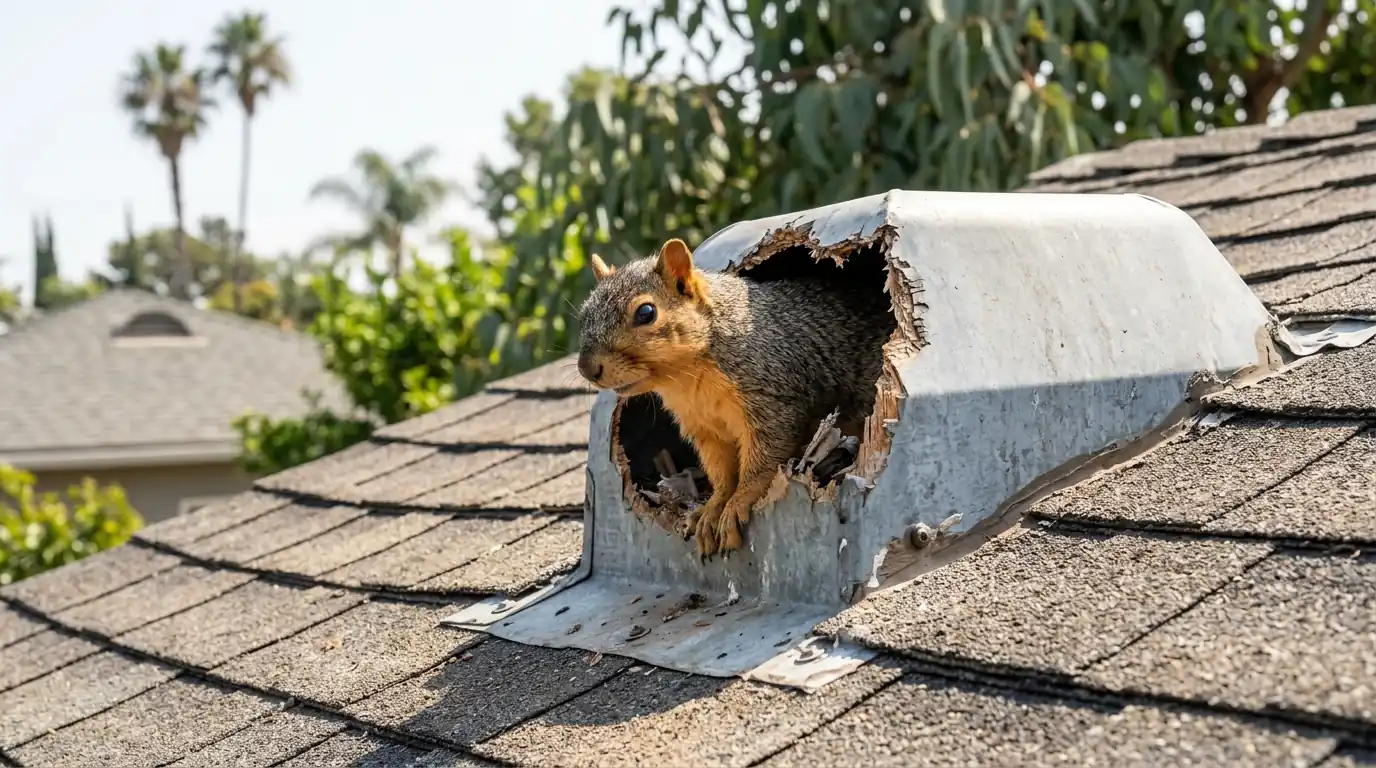
Gnawed roof vents, fascia corners and soffit edges, often near overhanging branches.
Nesting material
Leaves, insulation and shredded material packed into attic corners.
Garden damage
Fruit stripped from trees, bulbs dug up and irrigation lines chewed.
How removal works
Out through a one-way door, sealed behind
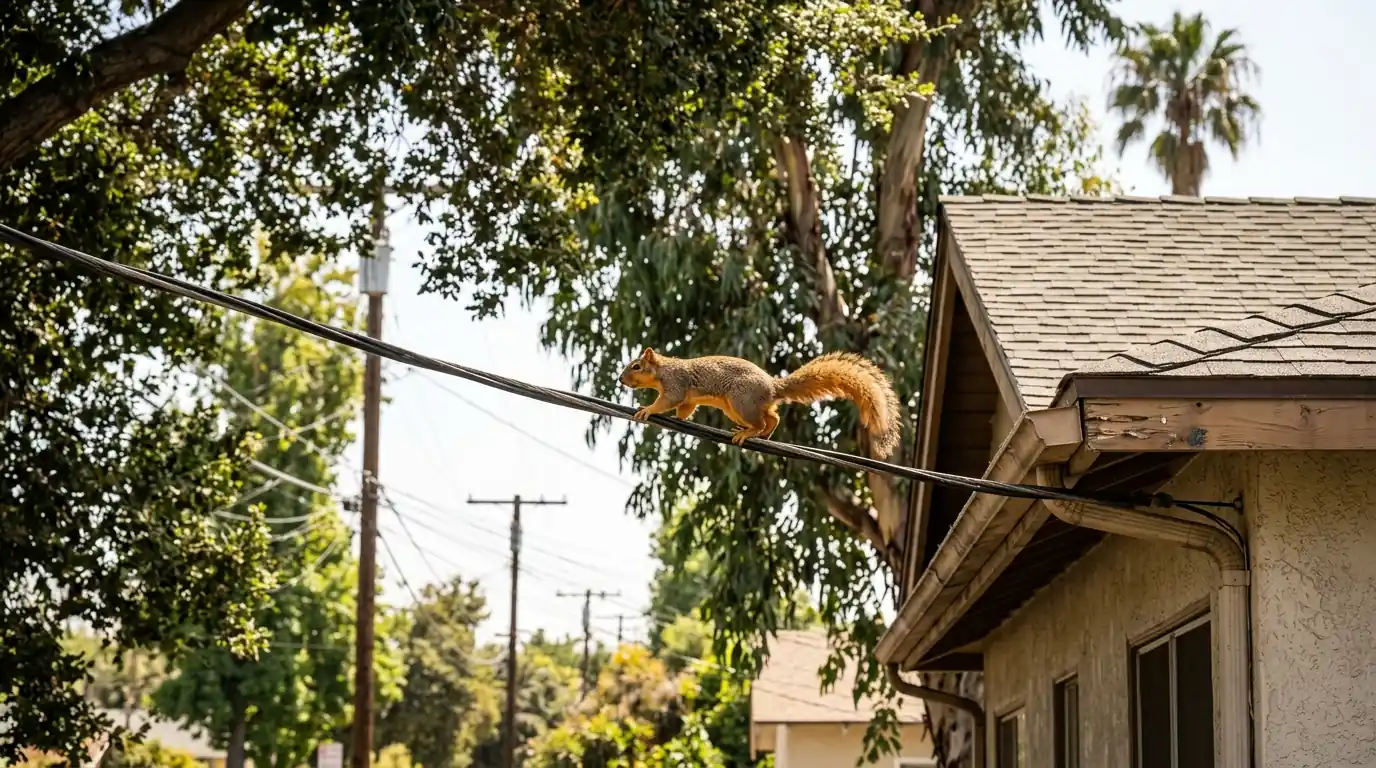
Tree squirrels get into attics from above: they jump from branches and utility lines to the roof, then chew through the weakest point they can find, an aging roof vent, a fascia corner, a gap where the roof meets a wall. Once inside, they nest in insulation, and their constant gnawing can reach wiring, which is the most serious risk.
Removal starts with the inspection: finding every entry and checking whether a nest with young is present. With no young, a one-way exclusion door goes over the main entry so the squirrel can leave to forage and cannot get back in, while other gaps are sealed in metal and heavy mesh. With young present, the work is timed so the family leaves together. After the attic is confirmed empty, the entry is repaired and reinforced, branches over the roof are flagged for trimming, and nesting material is cleared, with attic cleanup scoped if needed.
California rules generally do not allow trapped wildlife to be moved and released elsewhere, which is why exclusion, letting the animal leave and closing the way back in, is the standard approach around homes.
The visit
From scratching to sealed
Inspect
Roofline, attic and trees checked for entries, damage and young.
Exclude
One-way door on the main entry; secondary gaps sealed.
Confirm empty
Monitoring until the squirrel and any young are out.
Repair and seal
Vents, fascia and roof gaps repaired in metal and heavy mesh.
Prevent
Branch trimming advice and cleanup of nesting material.
Local pressure
The fox squirrel city
The eastern fox squirrel is not native to California, but it has spread through much of the Los Angeles Basin over roughly the last century, helped by the city's mature street trees, backyard fruit and endless rooflines. In many flatland neighborhoods it has largely replaced the native western gray squirrel. Mature canopy over older roofs is the common thread in attic calls, which is why trimming branches back from the roof is as important as the sealing itself. The same roofline work also keeps out roof rats, which use the same highways at night.
What it costs
How squirrel removal is priced
Pricing depends on the number of entry points, roof height and type, whether young are present and how much repair the roofline needs, quoted after inspection. For scale, sealing work on a typical LA home runs in the $600 to $1,200 exclusion range, with roof repairs and attic cleanup listed separately.
Common questions
Asked before booking this service
Timing. Tree squirrels are active in the day, especially early morning and late afternoon, with louder running and scratching. Rats are mostly active at night. You may also see squirrels entering at a chewed roof vent or a gap at the roofline.
Mostly the eastern fox squirrel, a non-native species that has spread across much of the Los Angeles area over the past century. The native western gray squirrel is less common in the flats and is protected outside of hunting rules.
Yes. Fox squirrels can raise litters in late winter and again in summer. Excluding a mother while young are still in the attic leaves them stranded, so the inspection checks for a nest before any one-way door goes up.
Yes. They chew through roof vents, fascia and soffits to get in, and once inside they can chew wiring, insulation and stored items. Outside, they strip fruit trees and dig up gardens.
California rules generally do not allow trapped wildlife to be moved and released elsewhere, which is why exclusion, letting the animal leave and closing the way back in, is the standard approach around homes. A one-way door lets the squirrel leave, then the entry is repaired and sealed.
Related treatments
Often booked alongside this one
The line is on right now
Hearing running overhead in the morning?
Call and describe when it happens. The inspection finds the entry and checks for young before anything is sealed.
Answered 24/7, including weekends and holidays.
Call us or find us
- Phone
- (323) 329-3792
- Hours
- Open and answering 24/7, every day
- Service office
- 3123 Cahuenga Blvd W #390, Los Angeles, CA 90068
- Head office
- 7623 Atlanta Ave, Ste 284, Huntington Beach, CA 92646
- Coverage
- Los Angeles, Orange and neighboring counties