Termites
Drywood vs subterranean termites in Los Angeles
Los Angeles carries both termite families at once, and they need completely different fixes. Telling them apart is the first, and most important, step.
Updated October 2026
This guide, at a glance
- Written by
- Hazel Winslow, Pest Control Guides Editor
- Updated
- October 2026
- Reading time
- About 6 minutes
- Questions
- Call, answered 24/7
By Hazel Winslow, Pest Control Guides Editor. Updated October 2026.
Drywood termites live entirely inside wood, need no soil contact and leave hard six-sided pellets; subterranean termites live in the soil, build mud tubes to reach your framing and attack low in the structure. In Los Angeles one house can have both. Drywood is treated in the wood or by fumigation; subterranean is treated at the soil with a barrier or bait system. Call (323) 329-3792 for an inspection.
Side by side
The two termites at a glance
Where they live
Drywood: inside attic framing, eaves, trim and furniture. Subterranean: in the soil, commuting into the structure.
What they leave
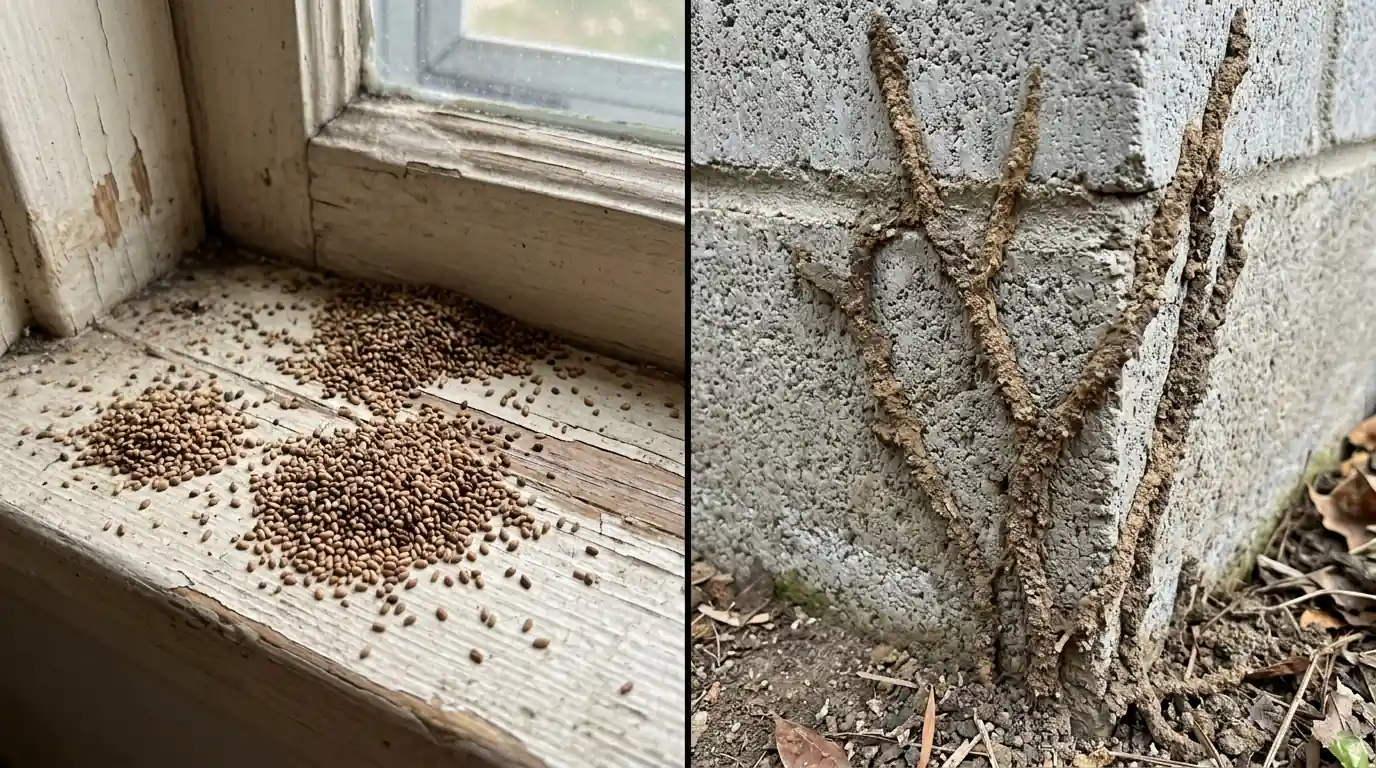
Drywood: hard six-sided pellets under kick-out holes. Subterranean: pencil-width mud tubes on foundations.
When they swarm
Drywood: warm days in late summer and fall. Subterranean: often after rains in late winter and spring.
How they are treated
Drywood: gallery injection or tent fumigation. Subterranean: soil barrier or bait stations.
Drywood termites
The colony inside the wood
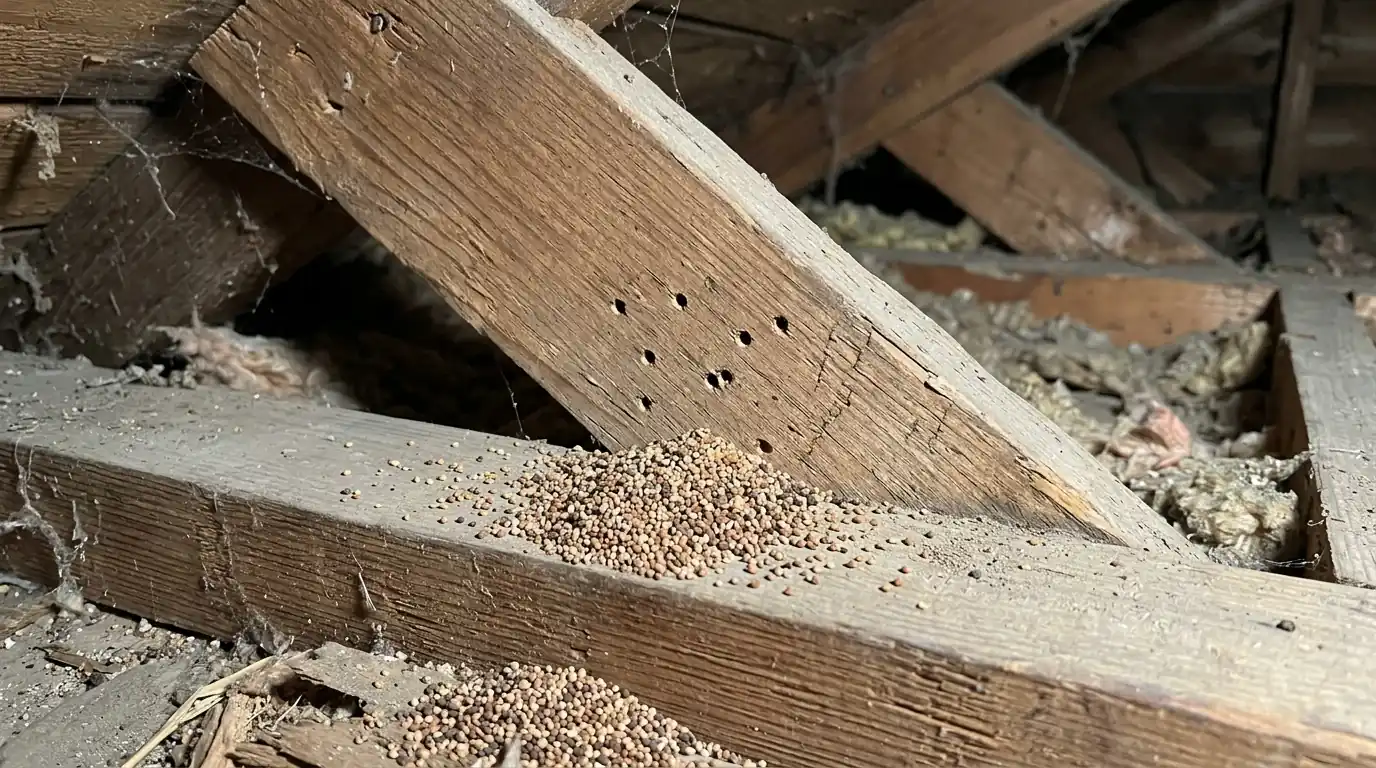
Drywood termites are Southern California's signature termite, and coastal Southern California has the highest drywood prevalence in the continental US. Winged swarmers land on exposed wood, a pair seals itself into a crack, and a colony grows inside the board for years, needing no contact with soil at all. The only outside evidence is what they push out: hard, six-sided pellets ejected through tiny kick-out holes, collecting in neat piles on sills, floors and attic insulation.
Treatment depends on spread. Localized, reachable colonies get drilled and injected directly, typically $300 to $800 in the LA market. When pellets turn up in several places, or galleries run into inaccessible framing, whole-structure fumigation at $2,000 to $6,000 is often the only method that reaches every colony.
Subterranean termites
The colony under the yard
Subterranean termites live in the soil in colonies that can run into the hundreds of thousands, and they cannot survive dry air, so they build mud tubes to travel from the ground into your framing. They enter through expansion joints, plumbing penetrations and slab cracks, and attack low and hidden: sill plates, bottom plates and the backs of baseboards. Swarms after rain and tubes found during unrelated work are the usual first signs.
Treatment meets them at the soil. A non-repellent liquid barrier along the foundation, or a bait system on their foraging routes, typically runs $800 to $3,000 in the LA market, with liquid work often priced at $3 to $16 per linear foot.
Why it matters in LA
Two pressures, one house
Los Angeles is one of the few places where a single house faces serious pressure from both families at once: drywood in the attic and eaves, subterranean at the foundation. That is why every proper inspection here reads for both, why fumigation alone never answers a subterranean problem, and why a soil barrier never answers a drywood one. It is also why escrow WDO reports in California so often list termite findings, a topic covered in termite reports in escrow.
Common questions
Readers also ask
Yes, and in Los Angeles it is common. Drywood colonies can live in the attic and eaves while subterranean colonies work the foundation from the soil, so one house can genuinely need two different treatment systems.
Subterranean colonies are much larger and can do more damage faster, especially low in the structure. Drywood colonies are smaller and slower but often more numerous, and multiple colonies in one house add up over years.
No. Fumigation treats the structure above ground, which is where drywood termites live. Subterranean colonies live in the soil outside the tent and need a soil barrier or bait system.
Drywood pellets are hard, six-sided and uniform, like coarse sand, often in neat piles under kick-out holes. Sawdust from carpenter ants is coarse, fibrous and mixed with insect parts. A photo usually settles it on the phone.
Related treatments
If this guide matches what you are seeing
Keep reading
More from The Bug Report
Termite Reports in California Escrow, Explained
Section 1 versus Section 2, who usually pays, and how buyers and sellers should read a WDO report.
How to Prepare for Tent Fumigation in Los Angeles
A plain checklist for the days before, during and after tenting, from bagging food to re-entry.
What Pest Control Costs in Los Angeles, CA
Market ranges for general service, termites, fumigation, bed bugs and rodent sealing, and what moves the number.
The line is on right now
Found pellets or a mud tube?
Take a photo and call. Telling the two termites apart often starts on the phone.
Answered 24/7, including weekends and holidays.
Call us or find us
- Phone
- (323) 329-3792
- Hours
- Open and answering 24/7, every day
- Service office
- 3123 Cahuenga Blvd W #390, Los Angeles, CA 90068
- Head office
- 7623 Atlanta Ave, Ste 284, Huntington Beach, CA 92646
- Coverage
- Los Angeles, Orange and neighboring counties