Spiders
Brown widow vs black widow in Southern California
Southern California has two widows now, and they do not hide in the same places. Here is how to tell them apart and keep them away from where your family sits and plays.
Updated October 2026
This guide, at a glance
- Written by
- Hazel Winslow, Pest Control Guides Editor
- Updated
- October 2026
- Reading time
- About 6 minutes
- Questions
- Call, answered 24/7
By Hazel Winslow, Pest Control Guides Editor. Updated October 2026.
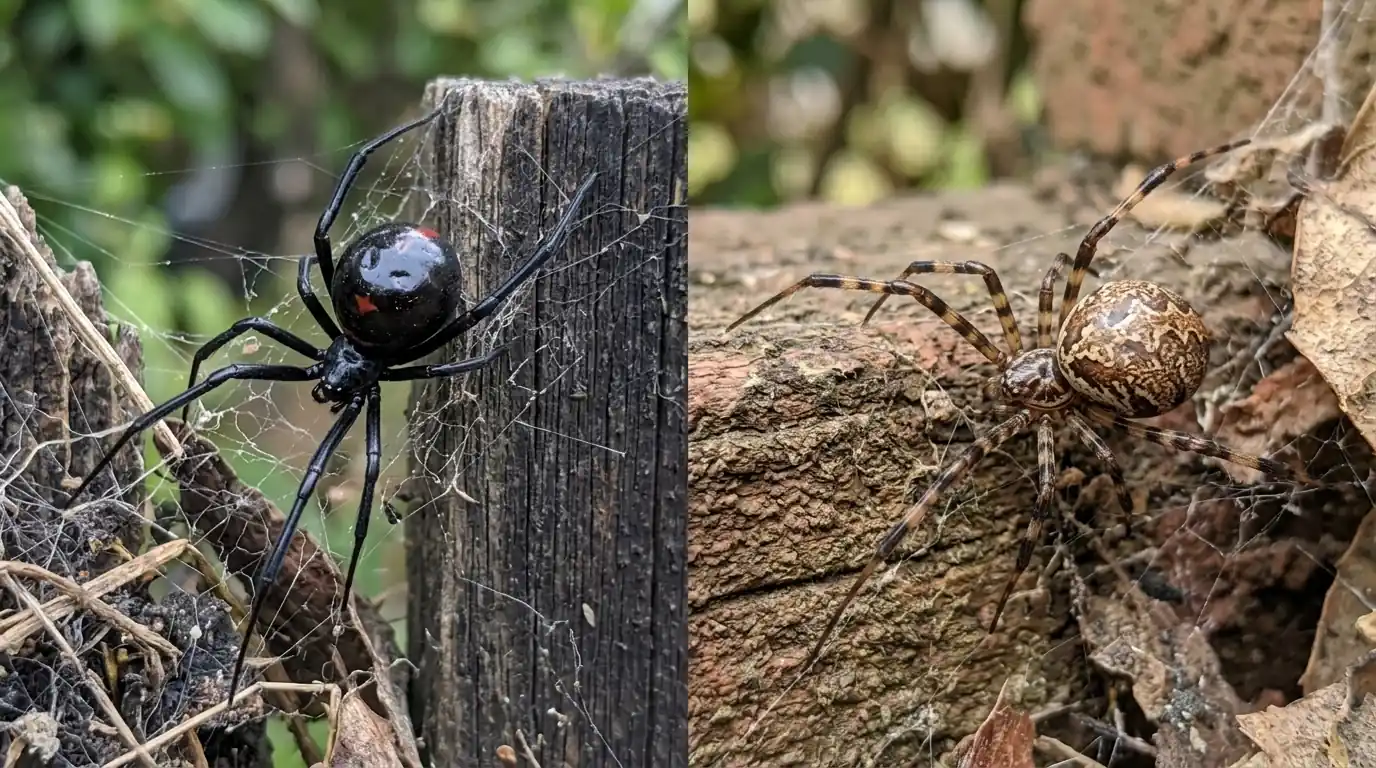
Black widows are glossy black with a red hourglass and hide low in dark, undisturbed gaps; brown widows are tan to brown with an orange hourglass, leave spiky round egg sacs, and favor patio furniture, railings and play equipment. Black widow bites are generally more serious. For any bite with significant symptoms, call Poison Control at 1-800-222-1222. For spider control, call (323) 329-3792.
Side by side
Telling the two widows apart
Color
Black widow: glossy jet black. Brown widow: tan, brown or gray with mottled markings.
Hourglass
Black widow: red. Brown widow: orange to yellow-orange.
Egg sacs
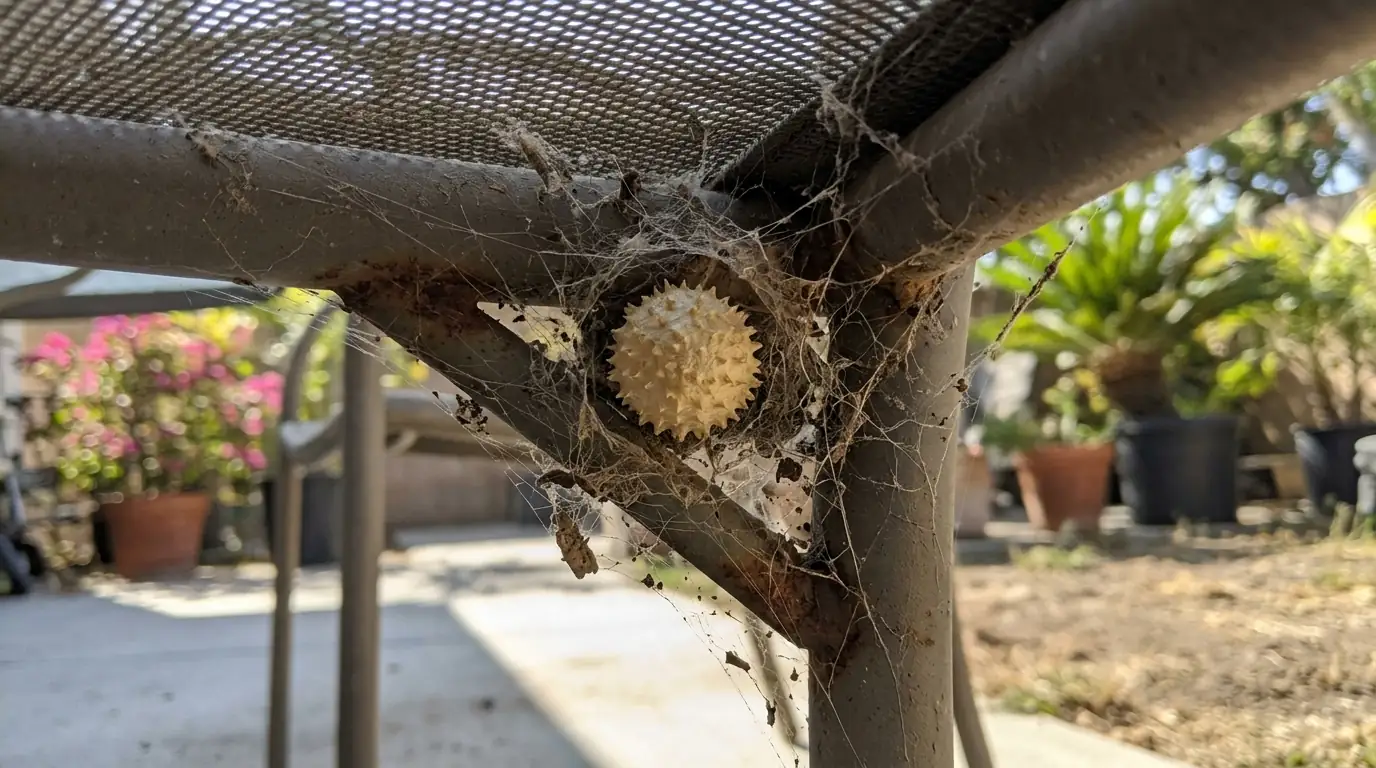
Black widow: smooth, round to teardrop, cream or tan. Brown widow: round with distinctive spiky bumps.
Webs
Both: messy, irregular and strong. Black widows build low; brown widows build almost anywhere.
Where each hides
Different neighborhoods of the same yard
The native western black widow likes low, dark, undisturbed places: gaps in block walls, water meter boxes, woodpiles, under stacked pots, garage corners and pool equipment. It tends to avoid busy areas, which is part of why black widow bites are relatively uncommon.
The brown widow is different. An invasive species first noticed in Southern California in the early 2000s, it has spread fast and now outnumbers black widows in many LA and Orange County neighborhoods. It builds under patio chairs and tables, along railings, inside children's play equipment, under eaves and around pool fences, places people touch every day. Spiky egg sacs tucked under a chair seat are the giveaway.
After a bite
What to do
Wash the bite with soap and water and apply a cool compress. Call Poison Control at 1-800-222-1222 or a doctor for guidance. Get emergency care for severe pain spreading from the bite, muscle cramps, sweating, nausea, trouble breathing, or any bite on a young child or older adult. Black widow bites in particular can cause significant symptoms that are treatable when people get care.
If you can safely capture or photograph the spider, it helps confirm what bit you. Many bites blamed on spiders turn out to be something else, and many suspected brown recluse bites in California are misidentifications, since brown recluses are not established in the state.
Keeping widows away
Around the patio and garage
Check under patio furniture, play equipment and railings regularly, and remove webs and egg sacs with gloves. Store pots, toys and lumber off the ground or in bins, clear clutter from garage corners, and wear gloves when reaching into meter boxes and woodpiles. Reduce the insects widows feed on with warmer-colored exterior bulbs and a perimeter treatment.
Professional spider control treats harborage directly, removes egg sacs across the property and cuts the insect prey that draws spiders in, often as part of a quarterly plan running about $150 to $250 per visit in the LA market.
Common questions
Readers also ask
The western black widow's bite is generally the more serious. Brown widow venom is potent, but they tend to inject less and bites are usually milder. Any widow bite with significant pain, cramping or other symptoms deserves medical attention.
Wash the bite with soap and water, apply a cool compress, and call Poison Control at 1-800-222-1222 or a doctor for guidance. Seek emergency care for severe pain, muscle cramps, trouble breathing, or any bite on a young child or an older adult.
The brown widow is an invasive species first noticed in Southern California in the early 2000s, and it has spread quickly through urban and suburban neighborhoods, favoring human structures like patio furniture, railings and play equipment.
Wear gloves, scrape sacs into a sealable bag or jar and dispose of them, and remove webs. Each brown widow sac can hold hundreds of spiderlings, so removing sacs matters as much as treating adults. Professional spider control treats harborage and removes sacs throughout the property.
Related treatments
If this guide matches what you are seeing
Keep reading
More from The Bug Report
Why Ants Invade LA Homes After Heat and Rain
Argentine ant supercolonies, why sprays backfire, and what actually stops the next invasion.
Why LA Mosquitoes Bite Your Ankles at Noon
The invasive daytime biters that changed LA backyards, where they breed, and how to take the yard back.
What Pest Control Costs in Los Angeles, CA
Market ranges for general service, termites, fumigation, bed bugs and rodent sealing, and what moves the number.
The line is on right now
Found an hourglass on the patio?
Leave it alone and call. Widow nests and egg sacs are a quick job for a technician and a risky one by hand.
Answered 24/7, including weekends and holidays.
Call us or find us
- Phone
- (323) 329-3792
- Hours
- Open and answering 24/7, every day
- Service office
- 3123 Cahuenga Blvd W #390, Los Angeles, CA 90068
- Head office
- 7623 Atlanta Ave, Ste 284, Huntington Beach, CA 92646
- Coverage
- Los Angeles, Orange and neighboring counties